A “10% fragrance load” is not a complete instruction. The missing question is: 10% of the wax, or 10% of the finished candle? The same percentage can lead to different wax and oil weights.
Start with the recommendation for your exact wax and candle type. Then check what the percentage is based on. The calculator comes after that.
If you need to find the amount of mixture your jar will hold first, start with How Much Wax Do I Need for a Candle Jar?.
Start here
- Find the fragrance limit for the wax you are using and the type of candle you are making.
- Check whether the percentage is based on wax weight or total finished weight.
- Work in grams or ounces on a scale.
- Make a test candle and record the result.
If the supplier does not name the percentage or its base, a number from another recipe is not a substitute.
“10%” can mean two different calculations
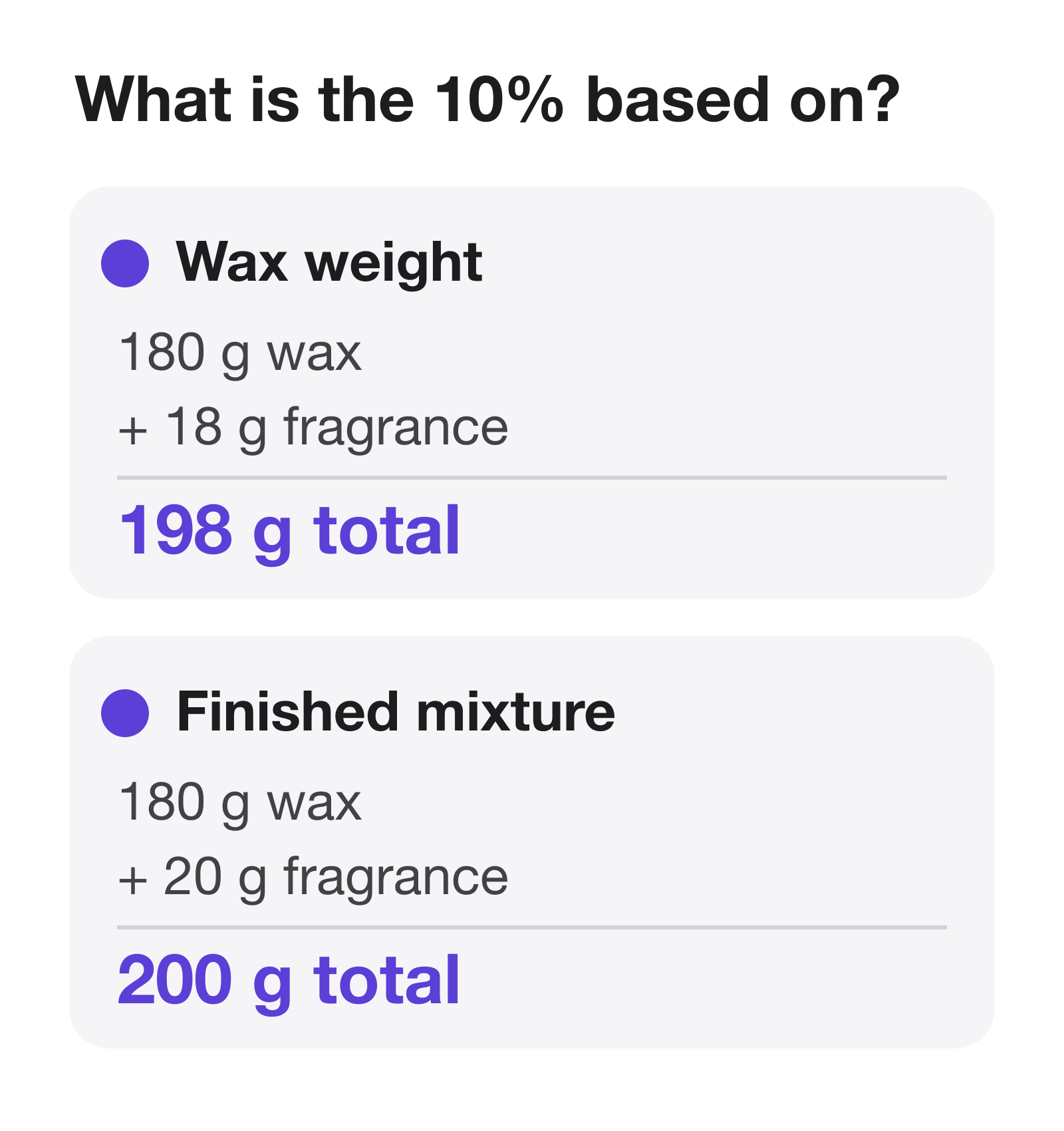
Start with 180 g of wax. The same label, “10% fragrance load,” gives different results depending on what the source uses as the percentage base.
When the percentage is based on wax weight
This is the model used by Lone Star Candle Supply’s fragrance calculator:
fragrance oil = wax weight × load
With 180 g of wax at a 10% load, the fragrance oil is 18 g. The finished mixture weighs 198 g.
If you need the finished mixture to weigh exactly 180 g, divide 180 by 1.10 first. That gives about 163.6 g of wax and 16.4 g of fragrance oil.
When a source defines the percentage against the finished mixture
If a source defines 10% as the fragrance oil’s share of the wax-and-oil mixture, 180 g of wax needs 20 g of fragrance oil. The complete mixture then weighs 200 g, and 20 g is 10% of it.
If your finished mixture should weigh 180 g at that same 10%, it contains 18 g of fragrance oil and 162 g of wax.
One table, no guessing
| What you know | 10% of | Wax | Oil | Mixture |
|---|---|---|---|---|
| You have 180 g of wax | the wax | 180 g | 18 g | 198 g |
| You have 180 g of wax | the mixture | 180 g | 20 g | 200 g |
| You need 180 g of mixture | the wax | 163.6 g | 16.4 g | 180 g |
| You need 180 g of mixture | the mixture | 162 g | 18 g | 180 g |
Convert before comparing two recommendations:
- 10% of the finished mixture =
10% ÷ (100% − 10%)= about 11.1% of wax weight; - 10% of wax weight =
10% ÷ (100% + 10%)= about 9.1% of the finished mixture.
Both calculations can be valid when the source states its base. They are not interchangeable.
Where the limit comes from
Do not choose the highest percentage you can find online. Look first at the product page or technical documentation for your wax, then at the documentation for your fragrance oil.
For example, CandleScience lists 10% or 1.6 oz per pound for container use of its EcoSoya CB-Advanced soy wax. A pound is 16 oz, so 1.6 oz per pound makes the base clear: it is 10% of the wax weight. That is guidance for that product and use case, not a rule for every soy wax. Lone Star likewise asks you to select a specific wax before showing its calculator guidance.
If two sources do not agree, first convert them to the same base. For a first test batch, use the lower value rather than silently choosing the higher one.
How I use Wax Lab
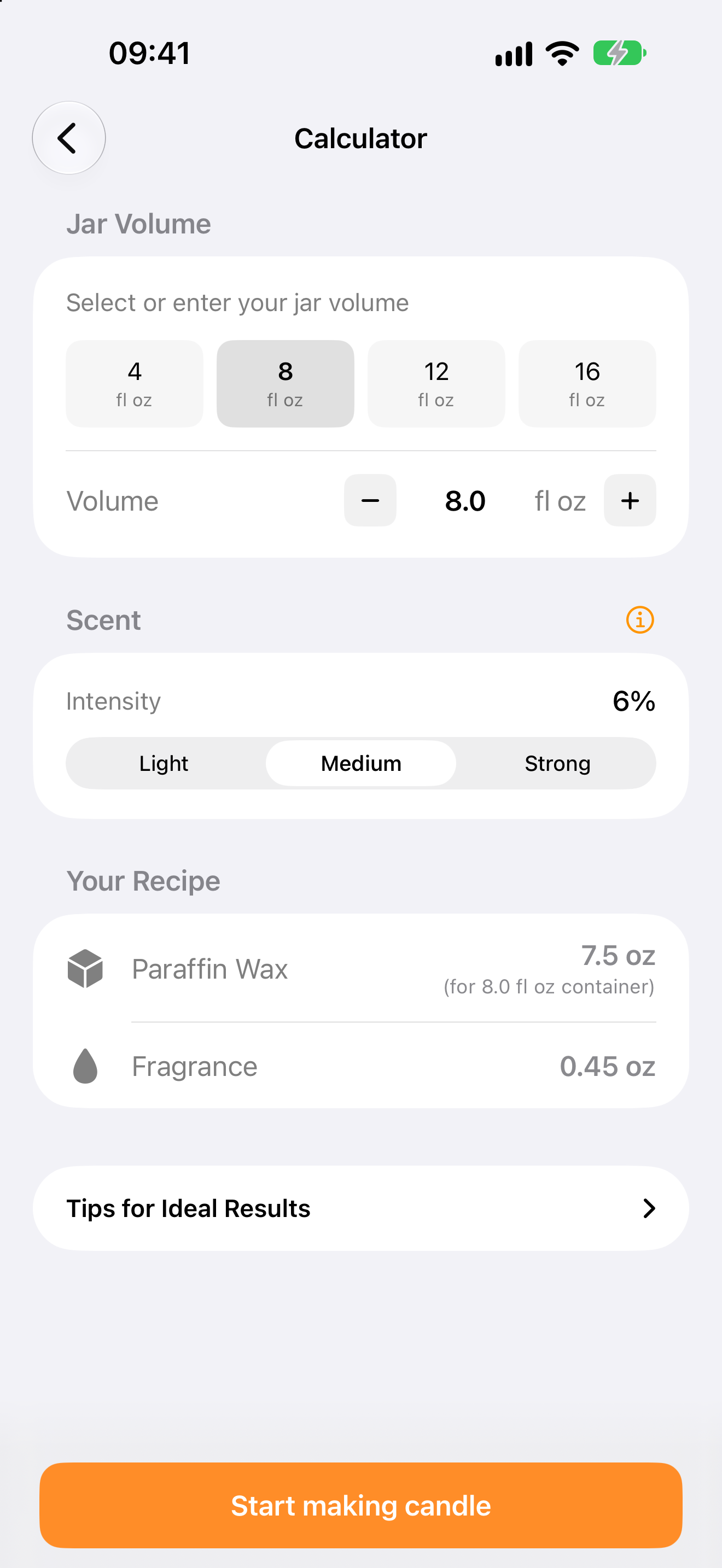
Wax Lab calculates fragrance as a percentage of wax weight and adds it separately. In its paraffin calculator, for a nominal 200 mL vessel, it shows 180 g of wax; at the medium 6% setting, it adds 10.8 g of fragrance oil. That is exactly 6% of 180 g.
That makes the arithmetic easier for a first test batch and gives me a recipe to record. The app does not know the technical documentation for every fragrance oil or the exact fill line of your jar. Material documentation sets the load; a test burn confirms whether the recipe works in your vessel.
What to record after the first batch
Write down more than the percentage: wax weight, fragrance weight, the wax and fragrance names, vessel, wick, and burn result. Then change one thing at a time in the next batch. That makes the comparison useful instead of relying on memory. My candle making journal guide includes a free printable template for these records.
Sources
The examples here are starting points for a test batch. They do not replace your material suppliers’ instructions or a test burn.