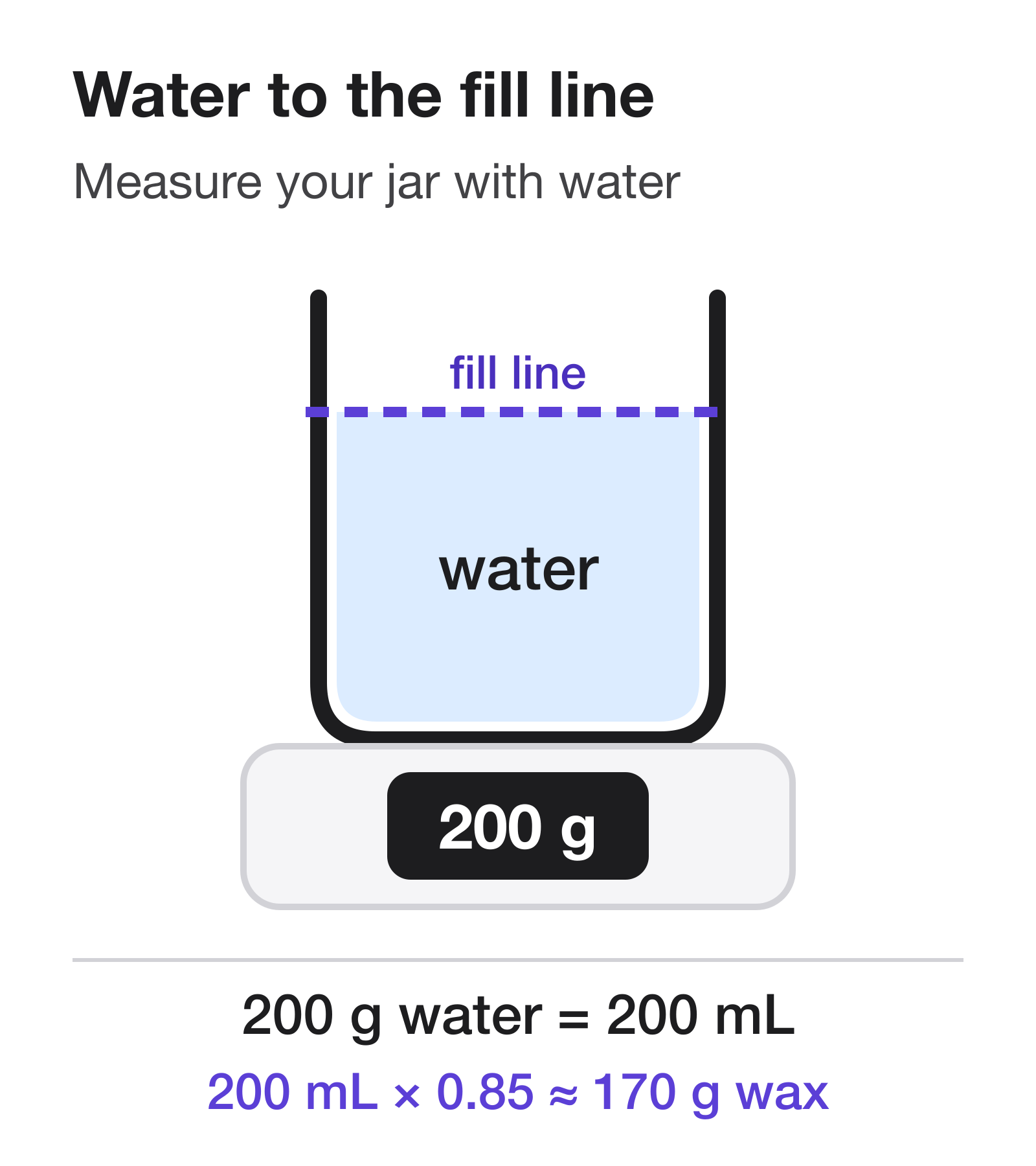
The best answer is not the number printed in a jar’s name. Start with the supplier’s Wax Weight (to Fill Line) if they publish one. If they do not, fill your own jar with water to the level you want, weigh it, and use a method that names the wax and the fragrance calculation behind it.
That gives you a useful first batch. A test burn decides whether it is a repeatable candle.
A jar’s label is not a wax recipe
Take CandleScience’s 8 oz. Candle Tin. Its product page lists two different figures:
- Wax Weight (to Fill Line): 5.00 oz (141.75 g)
- Volume (to Overflow): 8.50 fl oz
They answer different questions. The first is the supplier’s estimate of how much wax the tin holds at its fill line. The second is liquid volume at the point of overflow. CandleScience also notes that a wax-weight estimate varies with both fill level and wax density, so it is more useful than a jar name but still not a universal recipe. Their container guide explains the distinction.
The page does not say whether that wax weight leaves room for fragrance. Treat it as a starting point for the wax, and check the fill level on your first pour.
For scale, 8.50 US fl oz is about 251 mL. That is the volume to the rim, not to the fill line, so the stated wax weight or your own measurement is a better guide than the number in the tin’s name.
When the supplier does not list a wax weight
Lone Star Candle Supply’s soy-wax guide uses a simple starting method:
- Put the empty jar on a scale and tare it.
- Fill it with water to the height you intend to pour the candle.
- Multiply that water weight by about 0.85 to estimate the soy wax for one jar.
- Add fragrance separately, using a percentage of the wax weight.
For example, if 200 g of water reaches your chosen fill line, this method starts with about 170 g of soy wax. At a 6% fragrance load, that is 10.2 g of fragrance and about 180.2 g of total mixture.
This is Lone Star’s method for soy wax, not a density rule for every wax. Their fragrance calculator guide also makes the base explicit: fragrance load is a percentage of wax weight. Always use the limits for your own wax and fragrance oil.
Wax first, or the whole mixture
The multiplier only makes sense when you know what it represents. A method may start with wax and add fragrance on top, or start with the target mass of the whole mixture. Before choosing a formula, check both the wax and the percentage base.
How to Calculate Fragrance Oil for Candles shows how the two bases change the grams in a recipe and how to convert between them.
What Wax Lab shows
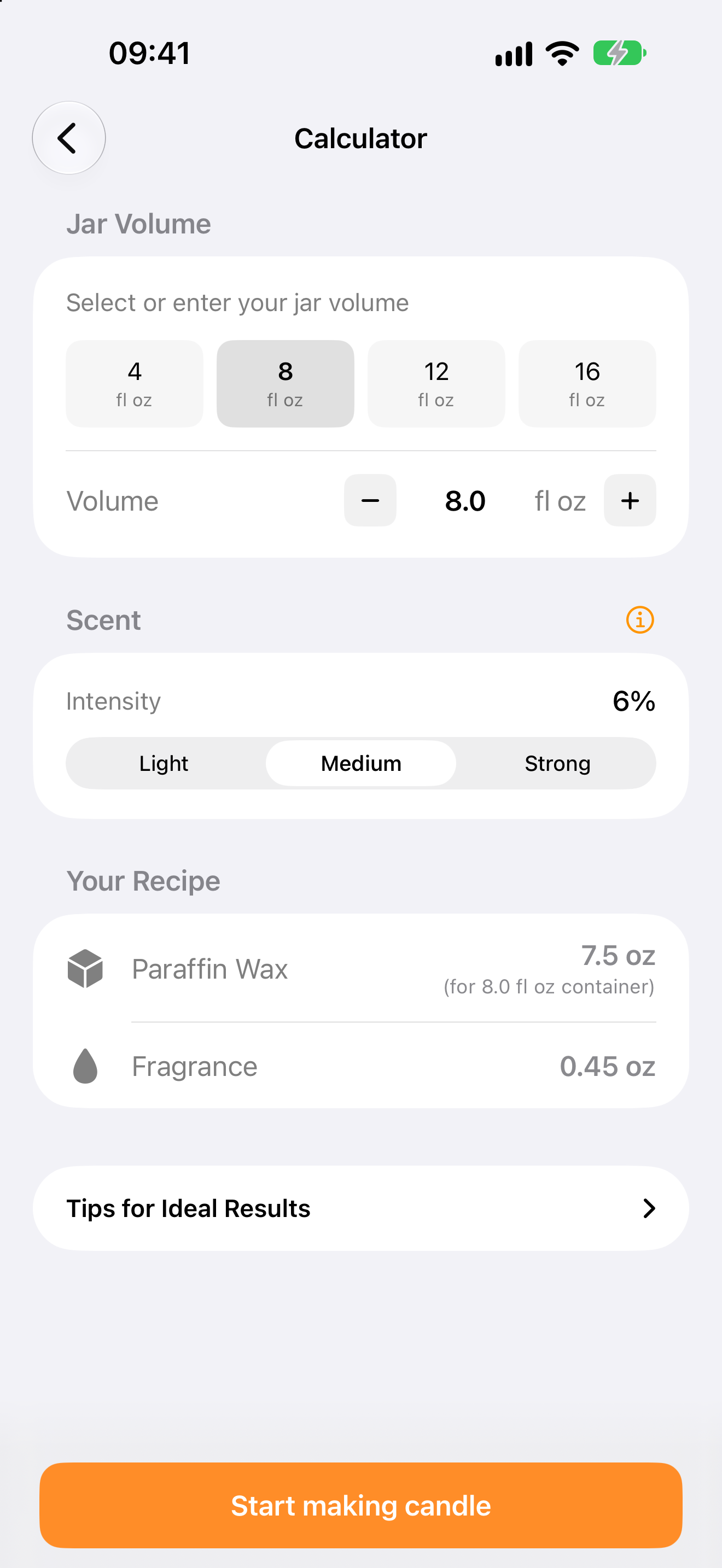
Wax Lab uses a different planning estimate in its paraffin calculator. Choosing a nominal 200 mL vessel starts with 180 g of paraffin wax. Fragrance is then added on top of that wax weight: 9.0 g for a light setting, 10.8 g for medium, and 14.4 g for strong.
In other words, this setup uses 200 × 0.9 for the wax first, then calculates fragrance separately. It is useful when you are planning what to buy, but it is not a promise that every 200 mL jar will fill to the same line. If your supplier gives a Wax Weight to Fill Line, or your own water measurement gives a better target, use that figure for the pour.
This example is specifically the paraffin setup. It does not claim the same calculation for soy or every other wax.
Your first candle is still a test
Numbers get you to a sensible first pour; they do not prove that a wick, wax, fragrance, dye, and vessel will burn well together. The EcoSoya CB-Advanced technical data sheet says every combination must be tested. For that wax, it recommends checking the burn pool and wick mushrooming after the candle has cooled for 48 hours.
Write down the jar, fill level, wax weight, fragrance load, wick, and burn result. The next batch should start from what you tested, not from a number you are trying to remember.
Sources
- CandleScience: 8 oz. Candle Tin and Container Info
- Lone Star Candle Supply: How to Measure Soy Wax and Fragrance Oil Calculators
- EcoSoya CB-Advanced technical data sheet
The figures here are starting points, not a replacement for your wax supplier’s instructions or a test burn.